Politiken — 
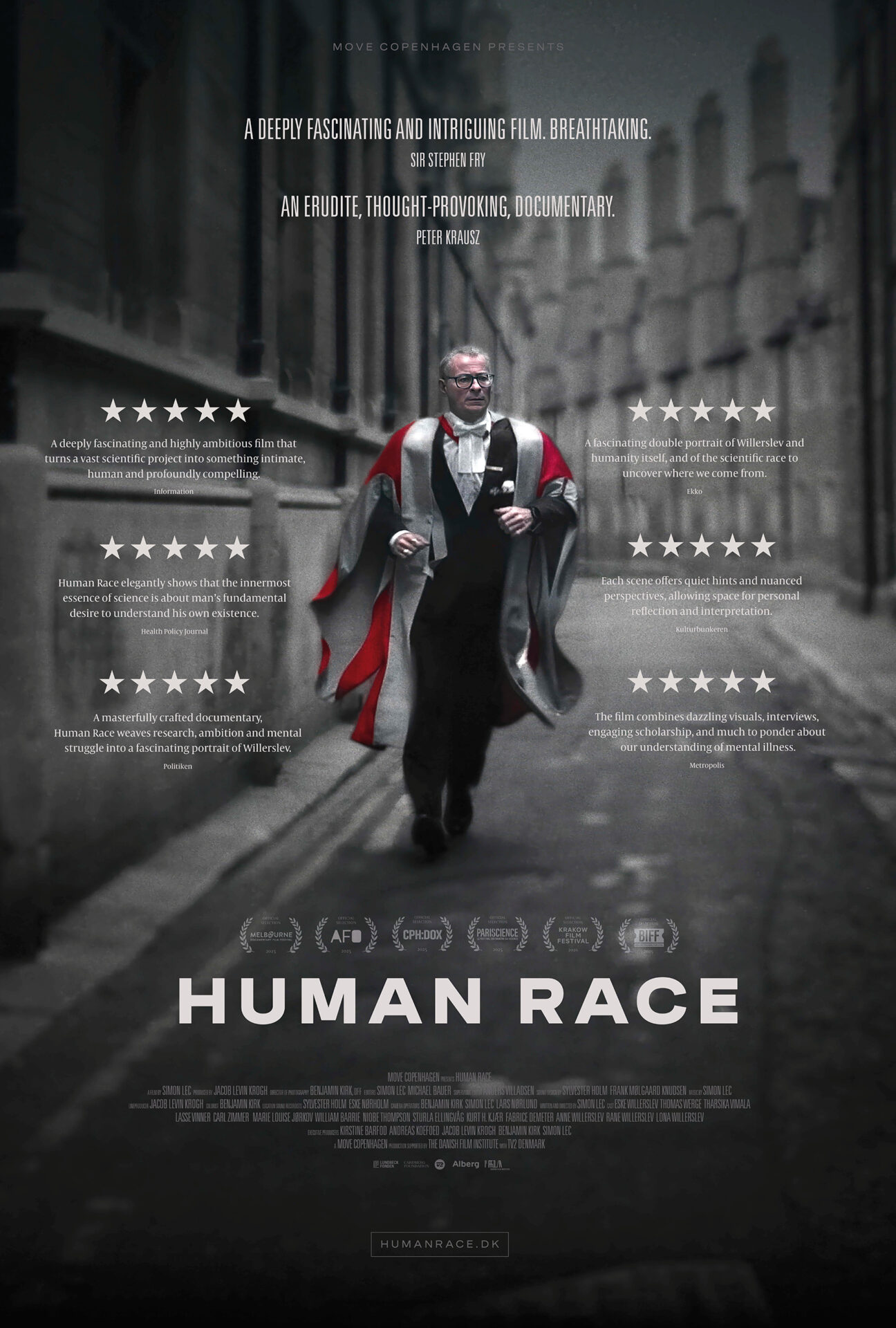
Politiken praises Human Race as a gripping, well-constructed portrait of both cutting-edge science and the man behind it. Critic Kim Skotte highlights the film’s ability to turn complex genetics into compelling drama driven by rivalry, ethical dilemmas and personal vulnerability. The documentary is described as a seamless blend of curiosity, ambition, and mental fragility — a work that leaves the audience “much wiser.”
Information
Information calls the film “deeply fascinating and highly ambitious,” emphasizing its success in transforming a vast scientific project into something intimate and human. The review highlights the film’s exploration of mental health, heredity, and identity, as well as its nuanced depiction of Willerslev’s upbringing, competitive nature and emotional life. The DNA sequencing itself is described as “elementally exciting” to follow.
Ekko — ★★★★★
Ekko describes Human Race as “intentionally crafted as a double portrait — of Eske Willerslev and of humanity as a species.” Kristian Ditlev Jensen praises the film’s elegant movement between micro- and macro-perspectives, its artistic precision, and its contemplative tone. He highlights the strong visual identity and the film’s deep emotional intelligence.
Kulturbunkeren — ★★★★★
Kulturbunkeren writes that audiences are “captivated from beginning to end.” The film is praised for generating drama from scientific competition, cultural conflict, and psychological struggle, rather than traditional action. The review highlights how the film raises major questions about heredity, culture, identity and mental disorders — and leaves viewers eager to learn more.
Sundhedspolitisk Tidsskrift — ★★★★★
Sundhedspolitisk Tidsskrift describes the film as “inspiring and empathetic.” The review praises its accessible communication of complex research and its human-centred storytelling. Human Race is highlighted for showing how genetic findings nuance our understanding of mental disorders, while portraying Willerslev as a driven yet vulnerable scientist navigating both professional and personal challenges.
Voices of Science — ★★★★★
Voices of Science calls Human Race “a subtle and thought-provoking work,” rich in interpretation and emotional nuance. The review emphasizes that the film invites reflection rather than offering simple answers, presenting its ideas with precision and understatement. It is described as a powerful, contemplative documentary that stays with the viewer long after the credits.
Kulturpanelet
Kulturpanelet highlights the film as a profound portrait of both the researcher and the human being behind the project. The review commends the documentary for integrating evolution, psychology, identity and ambition into a unified narrative, and for its strong visual expression. The film is described as intellectually stimulating and emotionally resonant.
Radio Shalom — ★★★★★★
Steen Møller Sørensen calls Human Race “vibrant, dramatic and exhilarating,” praising its visual strength, dynamic pacing and evocative musical score. The review notes the film’s balance of intensity, entertainment and human depth.
Lys! Kamera! Ord! — ★★★★
Per Juul Carlsen highlights Human Race as a visually striking, expertly crafted documentary that succeeds in transforming high-stakes research into an engaging human story. While the reviewer notes that the media world gravitates toward personalities over pure science, the film is praised for offering a surprisingly revealing portrait of Eske Willerslev — his intensity, humour, competitiveness, and the personal vulnerabilities that shape his work. The critic emphasizes that the film makes viewers “significantly wiser” about one of Denmark’s most talked-about scientists, portraying not only the global race to map the human genome but also Willerslev’s own struggles with bipolarity, creativity, and the pressures of scientific ambition. Even if the viewer must look elsewhere for deeper genetic explanations, Human Race is celebrated for delivering a compelling, character-driven insight into the human forces behind major scientific breakthroughs.
Connery — ★★★★★
Connery praises Human Race for asking one of the biggest questions of all: What does it really mean to be human? Reviewer Rasmus Krarup Jensen highlights that director Simon Lec is driven by far more than scientific curiosity — using the camera to explore identity, difference, and the universal struggle to fit into a world that often prefers uniformity. The film is described as essential viewing for anyone curious about why humans are the way we are.
CPH:DOX
Niklas Engstrøm praises the film for tackling the biggest questions — “What makes us who we are?” — while offering an unusually intimate portrait of Eske Willerslev. He describes Human Race as a documentary that combines scientific discovery with themes of identity, difference and the universal struggle to find one’s place in the world. According to Engstrøm, the film is far more than a science documentary: it is an existential exploration of humanity itself.
Movie Metropolis — ★★★★★
Movie Metropolis describes Human Race as “an erudite, thought-provoking documentary” that blends dazzling visual effects, rich interviews, and accessible scientific storytelling. Reviewer Peter Krausz highlights how sequencing over 5,000 ancient humans yields profound insights into mental illness and human variation, offering “much food for thought.” The film is praised for its intellectual depth, emotional resonance, and its ability to make complex research cinematic and engaging.
Sir Stephen Fry
Sir Stephen Fry calls Human Race “deeply fascinating and intriguing,” praising Eske Willerslev as “an extraordinary man” whose discoveries “turn so much of what we thought about human history upside down.” He describes the film as breathtaking — and concludes clearly: “Quote me as a supporter and admirer of this film.”
DR P1 — ★★★★★